
Why do we dream? 7 facts about the hidden science of sleep

Why Do We Dream? Did you know? Every night after you go to sleep, while your body is still, your brain is in a very active, vibrant, and sometimes mysterious world. Some days you are flying through the sky, and then another day you are running to escape from strange creatures you have never seen before. Even though we think “What crazy nonsense are these?” after waking up, dreams are actually an extremely complex and important process in the human brain.
“Dreams” have been a mystery since the beginning of human civilization. The ancient Greeks and Egyptians thought that dreams were messages from the gods. You may be thinking, ” What a crazy story this is. But the Greeks and Egyptians actually thought that dreams were messages from the gods. But now, neuroscience and psychology have revealed the real science behind dreams. In this article, we will explore the beginning and end of the dream world. Stay with us at infozage.com until the end of this interesting article.
1. Why Do We Dream? Where dreams are born or the scientific stages of sleep
We all dream not every moment of sleep. Sleep is not simply closing our eyes, but a cycle consisting of several stages.
NREM sleep (Non-Rapid Eye Movement)
This is the initial stage of sleep. Here, the body relaxes and enters a deep sleep. Although dreams can occur here too, they are often not remembered, no matter how much we try to remember them, and are very short.
REM sleep (Rapid Eye Movement)
The “superstar” of the dream world is the REM stage. This stage begins about 90 minutes after falling asleep. Here:
- No matter how much your eyes are closed, your eyelids move rapidly back and forth.
- Heart rate and breathing increase.
- Brain activity increases to the level when you are awake.
- The muscles of the body are temporarily paralyzed (Paralysis).
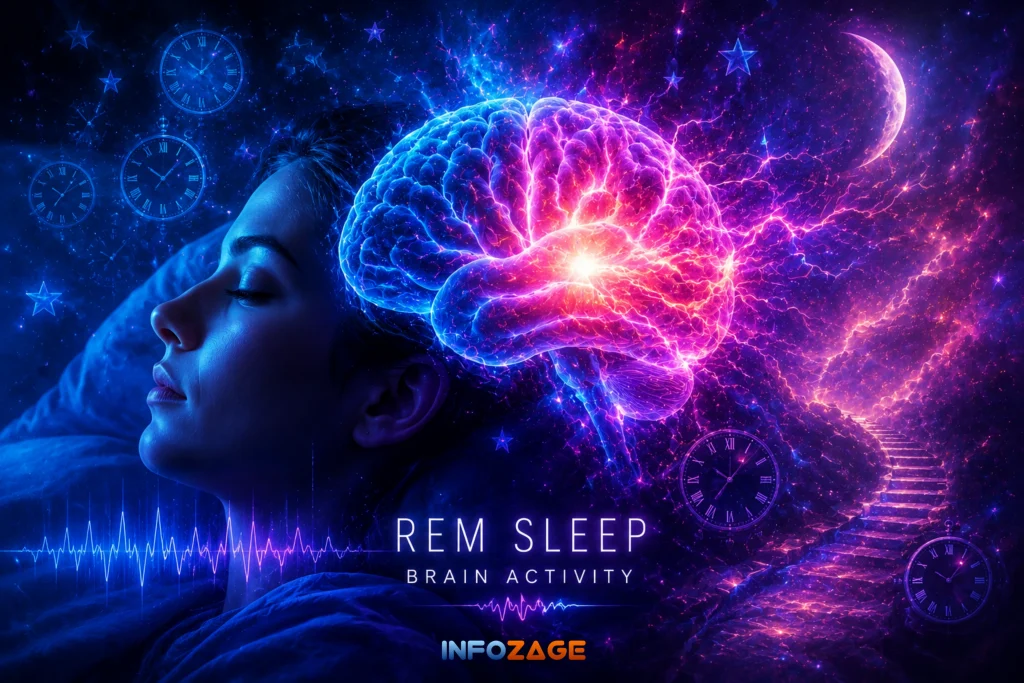
This paralysis is a wonderful creation of nature. Otherwise, you might actually do the actions you see in your dream (for example, hitting or running) and get into danger.
2. Why do we really dream? (5 main theories)
Scientists say that dreaming is not just something that happens; it is a necessary short-term maintenance process of the brain.
i. Memory storage (Information Processing)
Thousands of pieces of information that you see, hear, and read throughout the day are temporarily stored in the brain. At night, dreams “filter” this information. Dreams help remove unnecessary memories and send important information to long-term memory. When you learn something, your brain dreams about it as it tries to store that knowledge. In simple terms, it is about removing unnecessary information from our memory and retaining only what we need to remember.
ii. Emotional Therapy
Dreams are like our “night-time therapist”. The brain tries to reduce the pressure of those emotions by making you re-experience strong sadness, anger, or fear you felt during the day in dreams. It has been scientifically proven that dreaming can significantly relieve stress.
iii. Threat Simulation
We often have scary or distressing dreams (examples: being late for an exam, being chased by an animal, falling down a mountain). Evolutionists say that this is a habit inherited from our ancestors. The brain trains us in a safe environment (dreams) to deal with dangerous situations.
iv. Creative Inspiration
Many of the world’s most famous inventions and works of art have been created through dreams. The “periodic table” of chemistry, the sewing machine, and even the Beatles’ song “Yesterday” are the results of dreams. Since the logical part of the brain (Prefrontal Cortex) is paralyzed when dreaming, there is a clear space to build new ideas without restrictions.
v. Brain Cleansing
This is a recent discovery that toxins are removed from brain cells during sleep. It is now believed that dreaming may be a byproduct or stimulus of this process.
3. Strange features and mysteries of dreams
Faces We Know: Every person you see in a dream is someone you have actually seen somewhere in your life (on the road or on TV). The brain cannot create new faces.
Black and White Dreams: Surprisingly, about 12% of the world’s population only sees black and white dreams. It is widely believed that this is due to the black and white television programs they watched as children.
Dream Forgetting: Within 5 minutes of waking up, we forget 50% of our dreams. After 10 minutes, about 90% is forgotten. This is because the chemicals needed to store memories are not activated in the brain during the dream.
4. Lucid Dreaming: The Art of Dream Control

Many people achieve this state through training. This is a mental An effective way to increase self-confidence and get rid of bad dreams.
5. Why do nightmares occur frequently?
Frequent nightmares can be distressing. Let’s look at some of the main reasons for this.
1. Stress and anxiety:
The stressful issues in your personal life directly affect your dreams.
2. Irregular sleep:
When you don’t get enough sleep, your brain is very thirsty for the REM stage. Even during the short sleep you get at that time, you can have very intense and scary dreams.
3. Overeating:
Eating a heavy meal before going to bed increases the metabolism of the brain and starts stimulating nightmares.
4. Medications and drug use:
Certain medications can greatly change the chemical balance in the brain and cause nightmares.
6. How do you remember your dreams?
Try these tips to prevent yourself from forgetting your wonderful dreams:
- Dream Journal: Write down a brief note of your dream as soon as you wake up, before you get out of bed.
- Don’t move when you wake up: Moving your body too hard when you wake up can erase your dream. Try to recall it calmly.
- Get a good night’s sleep: The longer you sleep, the longer your REM stages of dreaming become.
7. Did you know? These are some amazing facts about dreams.
Animals also dream:
If your pet dog is kicking its legs while sleeping, it could be that your pet is running in its dream. It has now been scientifically proven that all mammals in the world dream.
Blind people also dream:
It’s surprising to hear this, isn’t it? Even though people who are born blind don’t dream visually, they can dream with sounds, smells, and touch.
Excessive dreaming:
We dream between 1400 and 2000 times a year. However, we can only remember a very small number of them.
In the end, we can say that dreams are the theater of the brain.
Dreams are not just nonsense or illusion. They are a process that is essential to your survival, your mental health, and your creativity. Your brain, which works hard all day, heals you at night through this wonderful world of dreams.
When you go to sleep tonight, get ready to enjoy the wonderful movie that your brain creates for you. Sometimes your next big achievement may be hidden in a dream you see today.
What is the strangest or scariest dream you have ever had? Comment below. If you think this information is important, share it with your friends.
Visit our blog regularly to read more scientific and intriguing articles like this that will drive you crazy.